What's New?
July 2026: Locatedness, Convexity, and Measurability in R^{N}
https://doi.org/10.48550/arXiv.2607.15558
This paper gives an improved, corrected, Bishop-style constructive development of two theorems originally presented in my paper number [33] --- namely:
Theorem 1. Let S = (S¹,S⁰) be a Lebesgue measurable complemented set in R^{N} with positive (possibly infinite) measure, such that S¹ is convex. Then S¹ is located in R^{N}.
Theorem 2. Let S be a Lebesgue measurable complemented set in R^{N} such that S¹ is convex and has inhabited complement. Then that complement is located in R^{N}.
In particular, where the original proof of Theorem 1 in my paper [33] applied only when S¹ was bounded, the new proof applies without that restriction.
June 2026: Notes on q-normed spaces in constructive analysis
https://doi.org/10.48550/arXiv.2606.25236
What we call q-normed (linear) spaces were introduced into constructive analysis, under the name pseudonormed spaces, by D.L. Johns, as a means of handling spaces like L_{∞} in which not all elements are constructively normable. We prove a number of q-normed-space analogues/ generalisations of standard theorems in the constructive analysis of normed linear spaces, and give examples showing that two natural analogues are essentially nonconstructive.
Constructive Notes on Locally Convex Spaces
https://doi.org/10.48550/arXiv.2606.12746
At the foot of pages 129 in book 7, in our discussion of locally convex spaces in constructive analysis, we wrote: "The proofs of the next five results are similar to those of their counterparts in metric space theory ... and are left as an exercise." It turns out that some of those proofs are not quite so straightforward as our quote suggests, and one theorem appears not to be constructively provable. In the present article we provide proofs of those results (corrected as necessary), as well as correcting some others in the book. To do so, we give an amplified presentation of some fundamental elements of the constructive theory of locally convex spaces.
Axiomatic Justification in Constructive Morse Set Theory
https://doi.org/10.48550/arXiv.2606.19707
Working within Constructive Morse Set Theory (CMST), we introduce axioms for a new notion, jstPp, intended to capture what it means for P to prove, or justify, p under the BHK interpretation of intuitionistic logic. Since it makes no distinction between terms and formulae---every term is also a formula, and vice versa---CMST is well suited to our axiomatic development of justification theory within set theory itself. After stating our axioms for jstPp, we derive many consequences thereof. In particular, we show that (with certain restrictions) our axioms for jstPp align with the intended BHK interpretations of the axioms of intuitionistic logic.
On Constructive Connectedness Properties
http://arxiv.org/abs/2606.08455
We plug two gaps in the constructive proof of Theorem 1 (respectively, Theorem 2) in my paper Connectivity properties of metric spaces (Pacific J. Math. 80(2), 325‒333, 1979), showing that the property of C-connectedness (respectively, O-connectedness) of a subset S of the real line is equivalent to S containing the interval [a,b] (respectively, (a,b)) whenever a and b are in S and a < b.
May 2026: The link to my journal article number 5, More on the connectivity of convex sets, has been corrected.
Addendum (on Carathéodory's Theorem), to paper 15
In my paper 15 Carathéodory's Lemma/Theorem is stated (as a lemma) without proof but with a reference to the classical proof in Cheney's classic approximation theory book. However, it turns out that proving that theorem constructively is a nontrivial matter. A constructive proof can be found in
Josef Berger and Gregor Svindland, A Constructive Version of Carathéodory's Theorem, in: Mathematics for Computation (M4C)
(M. Benini, O. Beyersdorff, M. Rathjen, and P. Schuster, eds), 133-142, World Scientific, Singapore, 2023.
This version requires the convex set to be totally bounded. Fortunately, the application of the theorem in my paper 15 is to the compact interval [0,1].
Closing in on the kernel of an operator between Banach spaces
http://arxiv.org/abs/2604.26259
This note deals with the question: If T:X→Y is a linear mapping between Banach spaces, x∈X, and ‖Tx‖ is small, is x close to the kernel of T? It draws on notions of Z-stability and provides an affirmative constructive answer when T is onto Y, sequentially continuous, and has located kernel.
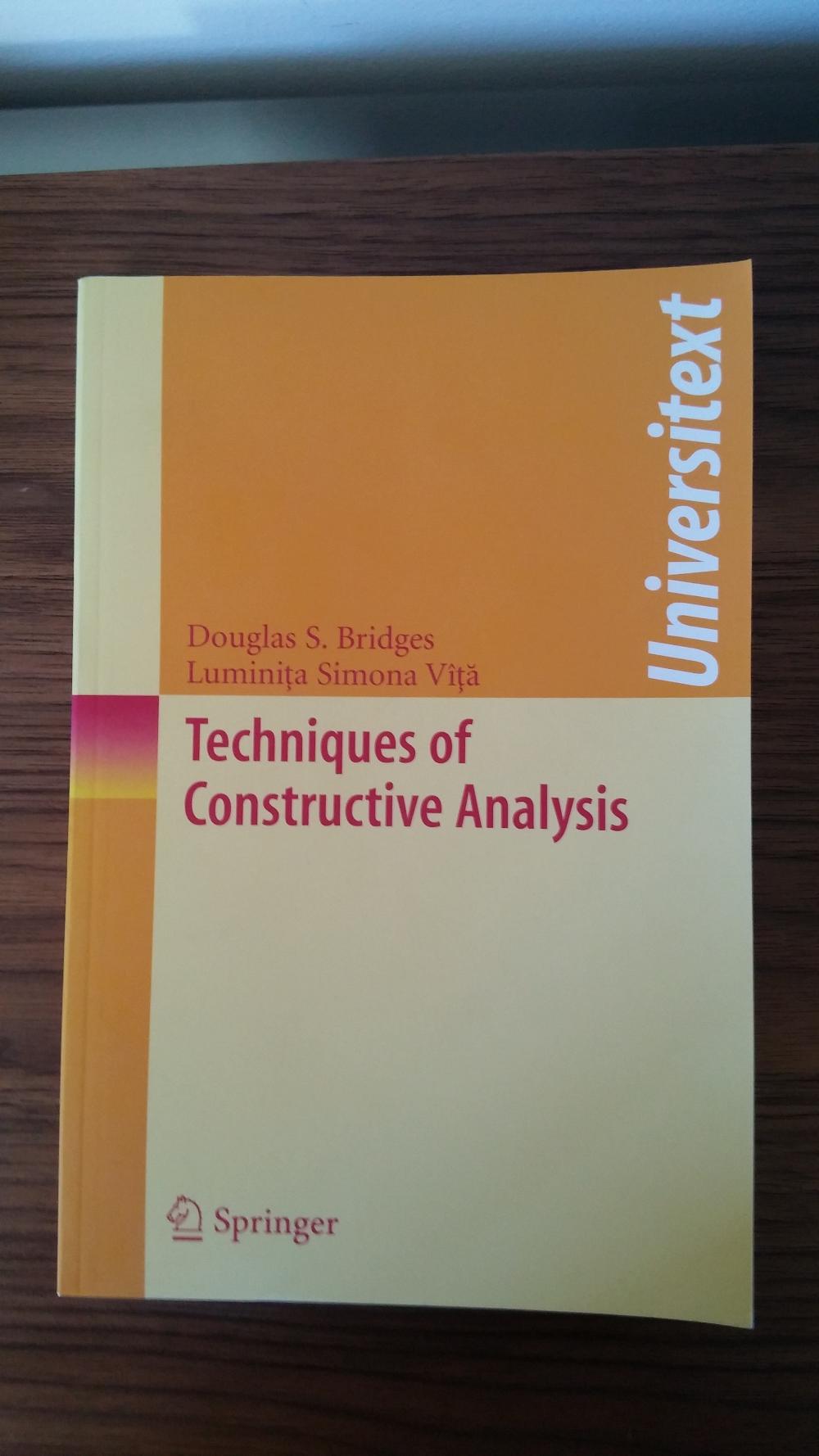
Mar. 2026: Correction to Lemma 2.5.3 of Techniques of Constructive Analysis
https://workdrive.zoho.com/file/vma4239a2b726c9f44d639367be925366fd92
Jan. 2026 : Addendum to paper 166 https://workdrive.zohoexternal.com/file/6t940223706629f6943cdae3223abf244c8ba
Correction to paper 153 https://workdrive.zohoexternal.com/external/
8a5163c8f157b13571d3a7f1c4acdb6734843894de09ee3b9561eae251a4f624
We indicate how the hypotheses in several lemmas and the main theorem Characterising weak-operator continuous linear functionals on B(H) constructively (my paper 153) can be simplified, and we give a corrected proof of Lemma 7 in that paper.
Dec. 2025: Correction to paper 160 https://workdrive.zoho.com/file/47nc6391aa22590e148e781bbd66c35e15d8d
Oct. 2025: Metric double complements of convex sets
https://doi.org/10.48550/arXiv.2510.15123
In constructive mathematics the metric complement of a subset S of a metric space X is the set -S of points in X that are bounded away from S. In this note we discuss, within Bishop's constructive mathematics, the connection between the metric double complement, -(-K), and the logical double complement, ¬¬K, where K is a convex subset of a normed linear space X. In particular, we prove that if K has inhabited interior, then -(-K) = (¬¬K)°, that the hypothesis of inhabited interior can be dropped in the finite-dimensional case, and that we cannot constructively replace (¬¬K)° by K° in these results.
Correction to Proposition 3.1.20, page 73 of Apartness and Uniformity - A Constructive Development
https://workdrive.zoho.com/file/vma4239a2b726c9f44d639367be925366fd92
Sept. 2025: Affine Hulls and Simplices: a Constructive Analysis
http://arxiv.org/abs/2509.20633
This paper deals with certain fundamental results about affine hulls and simplices in a real normed linear space. The framework of the paper is Bishop's constructive mathematics, which, with its characteristic interpretation of existence as constructibility, often involves more subtle estimation than its classical-logic-based counterpart. As well as technically more involved proofs (for example, that of Theorem 29 on the perturbation of vertices), we have included a number of elementary ones for completeness of exposition.
Mar. 2025: Monotone convergence theorems equivalent to Markov's Principle
http://arxiv.org/abs/2606.08863
The notions of provisional, negative, and apparent convergence to 0 are introduced. It is then shown that Markov's principle is equivalent, in Bishop's constructive mathematics, to the statement every decreasing sequence of real numbers provisionally convergent to 0 actually con- verges to 0, and that this equivalence holds with provisionally replaced by negatively. Finally, apparent convergence and convergence are related by means of the anti-Specker principle.
Corrigendum to paper 112
https://workdrive.zoho.com/file/v10n5fbbf506d7a424a80b3a1583922138672
As it stands, Theorem 3.2 of suffers from a hypothesis that is satisfied only in the case 1-by-1 games. This corrigendum removes that defect.
Feb. 2025: Expanded corrections to Techniques of Constructive Analysis (Book publication 7)
https://workdrive.zoho.com/file/f16vv8c41ca3ec3c24234b5bf81cf2512feb2
Correct version of Lemma 5.4.9 in Techniques of Constructive Analysis
https://workdrive.zoho.com/file/f16vv20df3d9680d04790abb647ed4fa5603f
The main point of this article is to present a corrected version of an important lemma in the constructive theory of locally convex spaces. We also outline some results, dealing with weak-star and weak-operator continuity of linear functionals, for whose proofs the lemma is important. The work is set in the framework of Bishop's constructive mathematics.
.jpg)